
Introduction
What is it like for me to live with Avoidant Restrictive Food Intake Disorder? How does this eating disorder affect me and my diet? How do I live through life with this disorder?
Read on in this exciting blog post to find out why I have an extreme dislike for textured foods.
What is ARFID (short for Avoidant Restrictive Food Intake Disorder)
Avoidant Restrictive Food Intake Disorder (ARFID) is an eating disorder that is characterised by an extreme reluctance to eat. The reluctance may be out of fear of choking on food, fear of certain textures in the food (which is known as tactile hypersensitivity, and this was a big problem for me), and the anxiety from this is why I have fear of trying out new foods. From infancy, I always had a problem with gaining weight and was extremely underweight. Social interactions and daily tasks were also a highly significant struggle.
Individuals with ARFID are different from “picky eaters” (Wikipedia contributors, 2024), where a picky eater (usually from childhood) may outgrow this habit. In ARFID, these selective eating habits are extreme and lifelong. Because of the extremely self-restricted diet, these individuals often miss out on essential vitamins, minerals and other necessities required for the body to grow and function. A “lack of appetite” being a reason for not eating.
Avoidant restrictive food intake disorder is a relatively new diagnosis that was added to the fifth edition of the DSM-5 in 2013, which extended and replaced the diagnosis of “feeding disorder of infancy or early childhood” that was included in editions prior to the DSM-5. This was also later included in the eleventh reiteration of the International Classification of Diseases (ICD-11) that was published in 2022. (Wikipedia contributors, 2024)
Signs of Avoidant Restrictive Food Intake Disorder
The signs of avoidant restrictive food intake disorder are:
- Extreme reluctance to eat.
- Difficulty in trying out new foods.
- Eating only a very small range of foods (for me, these are hot chips (known as fries in America), hash browns, white bread or chocolate for instance. I also have celiac disease, so all of my foods must also be gluten free (GF))).
- Refusing to eat vegetables/fruits/meats or any type of textured foods.
- Only eating foods with certain types of textures or a very uniform texture (like pureed fruits for example).
- Extreme dislike or fear of most fruits, vegetables or textured foods (neophobia).
Comorbidities with other conditions
ARFID is also a common comorbidity with other medical conditions. For example, the following conditions below often include ARFID:
Autism
In 2023, a study was conducted that revealed that autism and ARFID overlap significantly. About 8.2% to 54.8% of individuals with autism present with avoidant restrictive food intake disorder, and 17% of parents who have children with autism also have ARFID. (Keski-Rahkonen & Ruusunen, 2023)
Due to the sensory issues found in autism, the taste and texture of the food is greatly amplified which is also my experience. What is normally an enjoyable cookie to many is basically like eating gravel to my brain, so I avoid this kind of food and many others as much as possible. From my experience, pureed (liquid) fruit seems to work well for me. I am still learning to expand my diet today (almost 30 years on). 🥭

Created with the 3D modelling software Blender (version 4.0.2). Copyright © Zachary Wright.
Obsessive Compulsive Disorder
There is evidence that avoidant restrictive food intake disorder can co-occur with obsessive compulsive disorder. In a research case involving 90 individuals with avoidant restrictive food intake disorder, 6.1% of these individuals also had obsessive compulsive disorder. (Patterson, 2023)
ADHD
Attention deficit hyperactivity disorder (ADHD) can also lead to avoidant restrictive food intake disorder. ADHD is a neurodevelopmental disorder that leads to the individual struggling with attention spans, concentration, impulsivity control, which increases the likelihood of developing an eating disorder like ARFID. Studies from Eating Disorder Hope (2023) found that individuals with ADHD are much more likely to develop ARFID than neurotypical individuals. (Eating Disorder Hope, 2023)
How does ARFID affect my diet?
In earlier times, I had a diet that fit the criteria of avoidant restrictive food intake disorder. My diet has since been expanded upon to include 1 fruit (blueberries, bananas and mango), vegetables (tomato paste, finely chopped onions, butternut pumpkin soup, mixed garlic, potato in the form of hot chips) and meats (chicken & minced lamb, duck pate, scrambled eggs + flaxseed meal hidden in the food), but I still have difficulty coping with eating anything textured.
An example of how far I went to limit my diet was that I used to eat nothing but smooth peanut butter sandwiches (which I still enjoy), and I only ever drank Coke and chocolate milk, until my early 20s. 🥜🧈 I would happily enjoy this meal for breakfast/lunch/dinner/tea every day. I would still do this, however I am learning to increase my food repertoire through being willing to have a taste (1 teaspoon) of new foods & textures. With this method slowly I am adding new foods to my diet. (It’s a long journey!) 😆
The picture below shows a sample of how limited an individual’s diet could be with Avoidant Food Restrictive Intake Disorder.
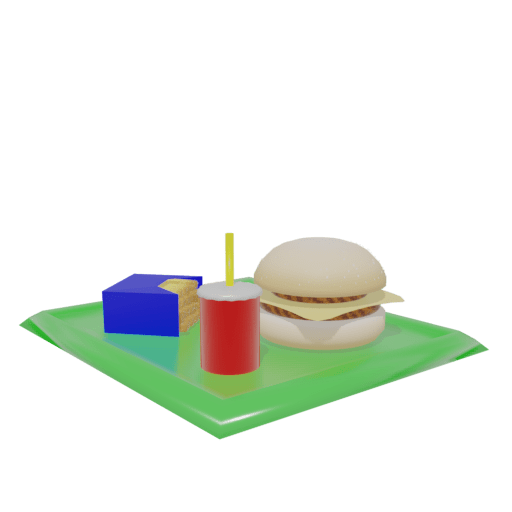
Image created with the 3D modelling software Blender (version 4.0.2). Copyright © Zachary Wright.
Can avoidant restrictive food intake disorder be managed?
Although avoidant restrictive food intake disorder can be successfully recovered from with the correct treatment and ongoing support (Walden Behavioral Care LLC, 2022), to state it can be “forever cured” would be ambitious.
From my experience, I found that the disorder could be managed by slowly introducing textured food or by making the fruit/vegetables smooth and not crunchy, although this may vary from individual to individual. Here’s a an example of how I have managed my avoidant restrictive food intake disorder that I have found that works for me.
Dietary strategies for managing avoidant restrictive food intake disorder
These are strategies that I have had some success with below with managing my ARFID. However, these strategies may not work for every individual.
Strategy 1: My experience with pureed fruits and vegetables
From my experience, pureeing fruits and vegetables has been a good strategy for managing ARFID, because much of the original texture disappears. As I have tactile hypersensitivity in the mouth, pureeing food allows for a more uniform liquid that still contains the original vitamins and minerals.
When it comes to seedy fruits, (such as strawberries, raspberries, watermelons), removing the seeds or straining the fruit into a liquid to smooth out the texture also helped greatly. The same can also be applied to vegetables. Another strategy I found was to puree fruits and vegetables together for a sweeter taste if preferred. 🍒
This process had to be done gradually over time to adjust my sensitivity to the change in food textures. We explored another idea which would involve diluting the pureed fruits and vegetables from their undiluted forms.
We slowly reintroduced less diluted versions of these drinks to get me used to the taste and texture of the pureed fruits and vegetables. By gradually expanding the variety of fruits and vegetables, I also managed to desensitise myself to their taste and textures.
Example shown below:
The above video clip shows an example of fruits in a pureed or liquid form.
Strategy 2: How I gradually introduced entire fruits and vegetables
In my experience, this strategy took much longer, my mileage (success rate) varied heavily depending on the type of fruit/vegetable being served. With personal encouragement and perseverance, I eventually succeeded in overcoming my biggest challenge regarding ARFID, and gradually start increasing my serving sizes. My eventual goal was to eat adult-sized portions of fruit and vegetable meals, first starting with tiny portions and slowly working to the full serving.
I learned that attempting to rush this process was maladaptive for me, as it would cause distress and made my fear of rough food textures more intense. While it was a difficult journey, I managed to successfully expand my range of fruits and vegetables. 😊
How I live with Avoidant Restrictive Food Intake Disorder
You might also be asking: “How do you live with this disorder?”. Read on to find out.
Avoidant restrictive food intake disorder makes eating outside the home extremely difficult unless it has my favourite foods. I find being a guest in other’s homes difficult with ARFID due to the social expectation to eat the food I am served, regardless if the texture is compatible with ARFID, due to this condition. Many people think I’m being difficult, but this is really ARFID, because the condition causes an intense amount of irritability due to fear when I am expected to eat a food I find difficult to process. This is a sensory issue, not a choice.
ARFID can result in a phobia of taste and texture – this is a food-based form of neophobia. Neophobia is the fear of new things or changes. (Wikipedia contributors, 2024)
My main carer will cook a healthy meal for me to eat which is an adult-sized portion. I am served scrambled eggs which I like as a nutritional alternative to solid meat, and I have gradually progressed since eating only scrambled eggs (for meat) to chewy chicken, which is now enjoyable to some degree for me. Due to my extreme reluctance, I usually leave foods with difficult textures for me, for the dog to enjoy. 🐶
Avoidant restrictive food intake disorder makes eating healthily a struggle for me, and it is very real! 😆
Princess Lilli Lilac

Although Princess Lilli Lilac doesn’t have anything much to do in the context of avoidant restrictive food intake disorder, she does help to keep me calm and relaxed. We have been inseparable since the day we first got her in 2011, and we love her very much.
Conclusion
I hope you have learnt a lot about avoidant food restrictive intake disorder (ARFID), and the daily management strategies that help me through it. This post has shown how the disorder impacts my life. If you would like to share any of your experiences with ARFID, please write in the comments section near the end of this post! I look forward to reading them. See you on the next blog post! 🗞
References
Keski-Rahkonen, A., & Ruusunen, A. (2023). Avoidant-restrictive food intake disorder and autism: epidemiology, etiology, complications, treatment, and outcome. Current Opinion in Psychiatry, 36(6), 438–442. https://doi.org/10.1097/YCO.0000000000000896
Patterson, E. (2023, March 21). Food aversion & ocd. Within Health. https://withinhealth.com/learn/articles/food-aversion-and-ocd
Wikipedia contributors. (2024, July 27). Avoidant/restrictive food intake disorder. In Wikipedia, The Free Encyclopedia. Retrieved 05:50, August 3, 2024, from https://en.wikipedia.org/w/index.php?title=Avoidant/restrictive_food_intake_disorder&oldid=1236906318
Eating Disorder Hope. (2023, April 6). Connections between adhd & avoidant/restrictive food intake disorder. https://www.eatingdisorderhope.com/blog/connections-adhd-avoidantrestrictive-food-intake-disorder
Wikipedia contributors. (2024, August 4). Neophobia. In Wikipedia, The Free Encyclopedia. Retrieved 00:42, August 23, 2024, from https://en.wikipedia.org/w/index.php?title=Neophobia&oldid=1238577424