Introduction to monologues
When it comes to conversing with others, we normally expand upon existing ideas, topics and other details that we are discussing. Each taking turns to inform. This type of conversation is known as a reciprocal conversation. But what if you couldn’t hold reciprocal conversations with others? We often see monologues presented in films and plays. There are some people who converse in monologues as a style of speaking.
A monologue is a type of conversation that is lengthy and goes into great detail about one subject. People who converse in monologues will often jump from one monologue to the next monologue, without waiting for a response from the other person or people in a group.
I am one of the individuals who speak in monologue. In this blog post, I explain why I talk in monologue, & why I prefer to avoid reciprocal conversations outside my family, and why I struggle so much with reciprocation.
Why are reciprocal conversations challenging for autism?
For those with autism, participating in reciprocal conversations can be extremely challenging. These challenges are arduous, similar to climbing a tall mountain. Those with autism often have intense struggles to comprehend social signals. These social signals can include the look on a person’s face, the tone of their voice and their body actions, all of which are crucial to reciprocation with others because these social signals form a language to neurotypical people (Jade ABA Therapy, 2026). However, to a person on the autism spectrum, these social signals are not perceived as language but merely movements of the body without meaning.
As reciprocity in conversation is overwhelming, those who are on the autism spectrum may choose to converse in monologues. The more severe the autism, the greater the likelihood that speech will be a monologue (Ochi et al., 2019). Typically, my monologues are about a specific obsession (such as the weather, cybersecurity and the Switch video game of the moment). In my experience, conversing in monologues gives me comfort because I’m in control (and there will be no surprises or changes).
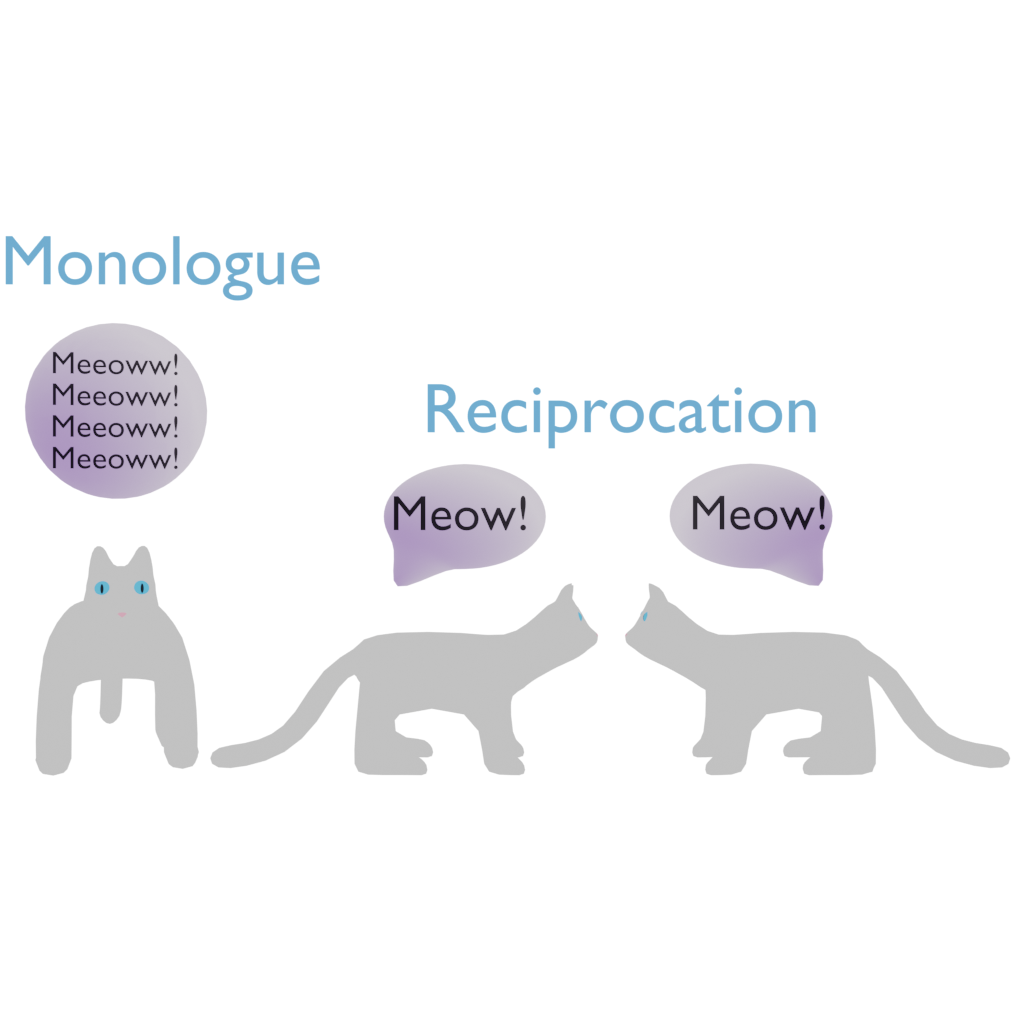
The challenge in these reciprocal conversations happens because the individual is unable to process empathy and relevance properly, leading to various attempts at trying to make sense of the conversation. This is also known as relevance theory as well as the double-empathy problem which is commonly seen in people with autism (Williams et al., 2021).
Why I prefer to avoid reciprocal conversations
I prefer to converse in monologues, because I have a fear of people judging me by what I say and how they will react to the conversation, such as anger, criticism, or leaving the conversation abruptly.
For this reason I prefer to converse in long, intricately detailed topics that often narrow to a single interest on whatever I am obsessed with at the time because it gives a sense of stability and control. When I’m not talking in monologue, I will bounce around topics, conversing about various random things such as the solar system, whats happening at present, the future, the past, anything really.
How I use monologues as a coping mechanism
I also find that monologue conversations have a therapeutic effect when I am stressed or highly anxious due to the repetition involved, a trait commonly found in OCD (which is one of my diagnoses). I also dislike waiting in conversations, as I am unable to perceive time (a trait also found in ADHD). The lack of time perception caused by my ADHD is also another reason why I prefer to talk in monologues as opposed to dialogues. This also causes me to interrupt conversations.
When my anxiety increases, I use monologue conversation as a coping mechanism, increasing the frequency at which I monologue to where most people find it distracting. When people tell me to slow down, it doesn’t help; it exacerbates the situation, which makes me unable to slow down or alter my speed. It’s akin to telling an angry person to calm down – it does not work. From my experience, this has the opposite effect and raises my anxiety, causing a negative feedback loop.
I have a lot of anxiety, uncertainty, stress and anticipation when meeting people I am not familiar with.
The emotional combination of anticipation, anxiety, uncertainty, and stress when I meet new people all cause me to revert to a state where I converse in monologues instinctually. Since I cannot maintain eye contact with anyone outside my family (excluding friends), I find it much more difficult to reciprocate with others in comparison to neurotypical individuals. As is common in people with autism, I can’t easily process body language or facial expressions. As I do not generalise, I have to learn every unique body language & expression for everyone that I meet. Therefore, a room with more than 8 people that I already know is exhausting for me, let alone new people.
As from a young age, monologue conversations became hardwired (which is an automatic behaviour) into my brain.
Although turn taking is hardwired into the majority of adult brains, many individuals with autism find learning how to take turns in conversations very challenging (CST Academy, 2024).
Examples of difficulties encountered include:
- Challenges with recognising social signals, making it difficult to know when they should talk or not
- A limited vocabulary (for some individuals) may make conversations more difficult
- Inability to focus and learn in loud environments from hyperacusis (elevated / hypersensitive hearing)
- Fixed thought patterns that can cause difficulties with taking turns in conversations
(CST Academy, 2024).
In individuals with autism, the ability to interact in conversations and use meaningful language is thought to be skewed, causing alternative patterns that use divergent thinking or delayed timings when it comes to turn-taking and reciprocal conversations (Wehrle et al., 2023).
Princess Lilli Lilac
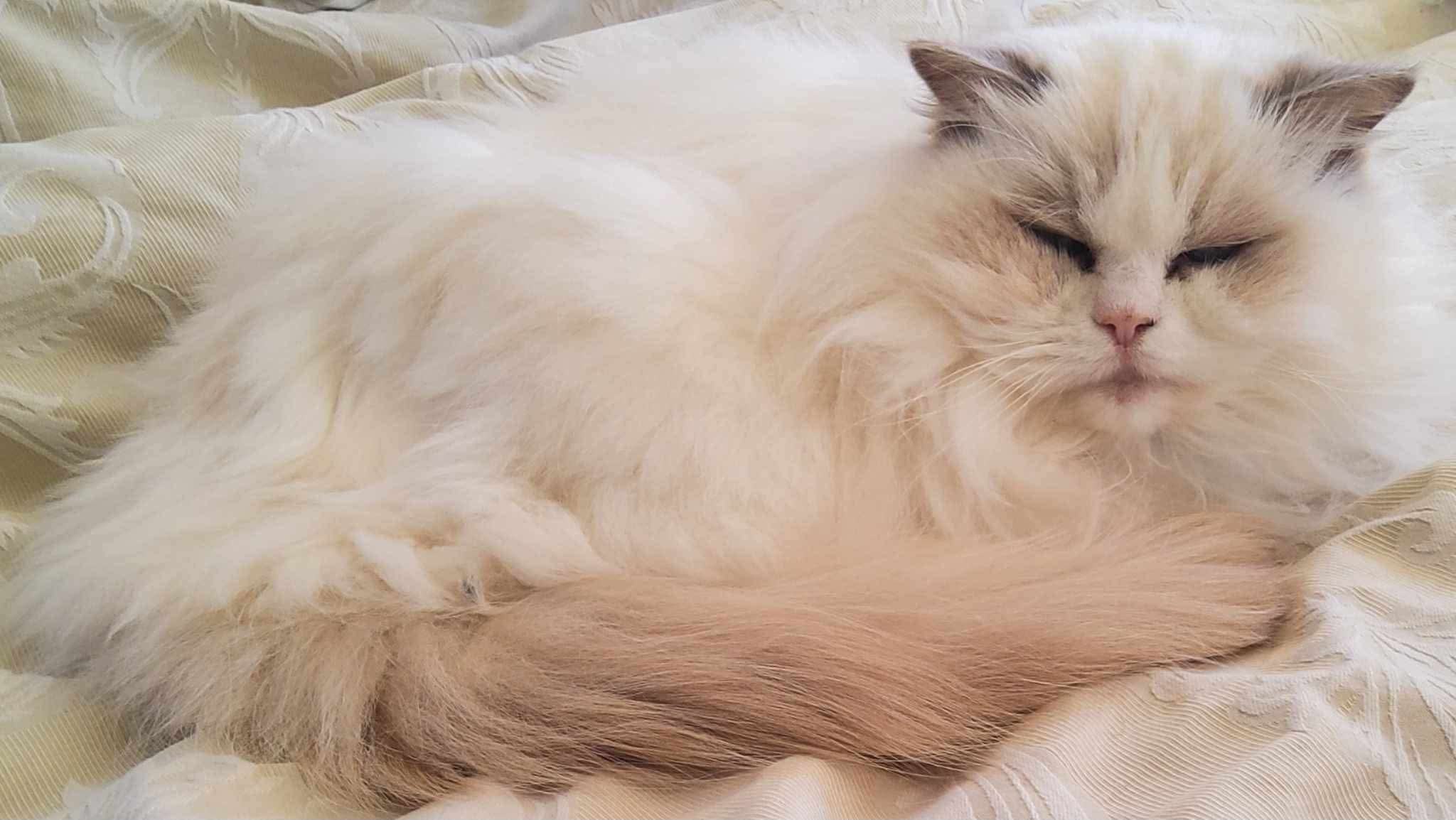
While cats don’t seem to care about our conversations as a whole, they are capable of knowing their names as well as being able to come when called. 😺
Cats also can ‘converse’ or ‘reciprocate’ with us by meowing and howling, although they are incapable of having intricate conversations compared to humans. Lilli and I have been inseparable since the day we first met each other and have loved each other ever since she was an 8 week old kitten. 💜
Conclusion
While I still find reciprocal conversations to be extremely challenging, I have improved somewhat, as I can reciprocate to some extent with people outside my family. However, I still naturally prefer to have reciprocal conversations with my carer and family because I know them very well and they won’t judge me or have unexpected reactions.
Feel free to leave your thoughts in the comments below and I shall see you on the next blog post! 📰
References
CST Academy. (2024, September 3). Why turn-taking matters: A key to speech and language growth for children with autism. https://cstacademy.com/resources/articles/why-is-turn-taking-important-in-speech-and-language-development/
Jade ABA Therapy. (2026, January 13). Autism’s impact on conversations & social reciprocity. Wayback Machine. https://web.archive.org/web/20260113122538/https://jadeaba.org/how-does-autism-affect-social-reciprocity-in-conversations/
Ochi, K., Ono, N., Owada, K., Kojima, M., Kuroda, M., Sagayama, S., & Yamasue, H. (2019). Quantification of speech and synchrony in the conversation of adults with autism spectrum disorder. PloS one, 14(12), e0225377. https://doi.org/10.1371/journal.pone.0225377
Wehrle, S., Cangemi, F., Janz, A., Vogeley, K., & Grice, M. (2023). Turn-timing in conversations between autistic adults: Typical short-gap transitions are preferred, but not achieved instantly. PloS one, 18(4), e0284029. https://doi.org/10.1371/journal.pone.0284029
Williams, G. L., Wharton, T., & Jagoe, C. (2021). Mutual (Mis)understanding: Reframing Autistic Pragmatic “Impairments” Using Relevance Theory. Frontiers in psychology, 12, 616664. https://doi.org/10.3389/fpsyg.2021.616664