Introduction to creativity and autism
As humans we are all creative beings in some way or another. Whether it be drawing, music, painting pictures or solving puzzles, we all express our creativity in a unique way. This aspect is true for individuals with autism as well.
In this blog post, we will dive into how creativity manifests in autism and how hyper-focus may play a role in creativity and autism.
How divergent thinking shapes creativity and autism
In contrast to neurotypical people, many people with autism face challenges when it comes to organised, structural thinking and an adaptable train of thought. This lack of abstract thinking and flexibility meant those with autism initially were mistaken by various researchers, for being less innovative than their neurotypical counterparts (Maykel et al., 2022).
In a select group of people who had autism, it was later discovered that they possessed unique abilities to create and see things in their mind, capturing the smallest details. The ability to hyper-focus on intricate details, conflicted with research which is focused on deficiencies instead of accomplishments (Maykel et al., 2022).
Some theories for why individuals with autism might excel in creativity, include having a heightened sensory experience, with unusually accurate attention to detail, and a desire to create frameworks based on past experiences (Maykel et al., 2022).
It is well known that individuals with autism have a different thought pattern to people without autism. Studies discovered that people with autism both had strengths and weaknesses when it came to creativity and divergent thinking tasks (Maykel et al., 2022). However, another study found that young males with mild autism were more adept at forming unique ideas and solutions when it came to divergent thinking, as opposed to their neurotypical counterparts (Maykel et al., 2022).
While convergent thinking aims to solve a problem with a logical single solution, divergent thinking takes the opposite approach and involves the generation of many unique and original ideas using creativity to solve a problem. Divergent thinking is related to creativity (Blue Gems ABA, n.d.).
Are individuals with autism creative?
According to the Diagnostic and Statistical Manual of Mental Disorders, Fifth Edition (DSM-5), one of the deficits of autism is impairment in the imagination (DSM-5; American Psychiatric Association 2013). Despite this, there are people with autism who excel with their imagination in creativity as artists and areas of special interest (Fitzgerald, 2004). Some of these artists are known to have savant abilities. Therefore, the idea that people with autism cannot be creative or display high standards of creativity would be incorrect. The tendency to explain autism through a deficit-only lens does not explain the anomalies of high creativity amongst some people with autism (Happé, 1999).
In a study known as the Alternate Use task (Guilford et al. 1978) candidates were required to come up with unique alternate ways to use an everyday object such as a brick or a drawing pin to test whether people with autism could create new and appropriate ideas through divergent thinking. The candidates also were required to suppress convergent responses and use divergent thinking to create unique ideas.
The study found that there was strong support for divergent thinking in people with autism (Best et al., 2015).
The video clip shown below is an example of how divergent thinking and creativity both can be used with 3D modelling software including Blender to create a unique oceanic scene like this one:
My experience with creativity and autism
In my personal experience, I show the most creativity when using computers. Software that encourages creativity such as Blender (a 3D modelling suite) allow me to produce my own content.
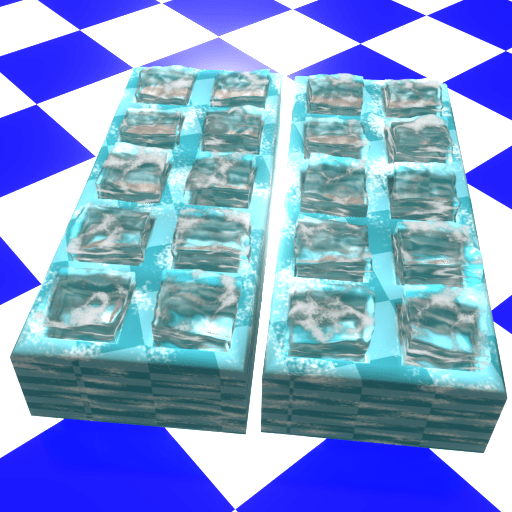
An example of a picture made with Blender can be seen below. The ice cube trays, floor and their textures were all made with Blender and rendered into an image. This shows how creative I can be when it comes to modelling and creating my own original works through software:
Blender’s versatility also allows me to create videos for this blog as well. The red sunflower-daisy below is another example of creativity used in Blender to create a flower that will surely brighten your day. Trivia: This clip is also found on the blog’s homepage! 😃
How video games influenced my creativity
The game engine counterpart to Blender is a separate application based on Blender known as UPBGE. In contrast to my usage with Blender, I prefer to use UPBGE for personal use and creating my own personal game projects. The name UPBGE stands for “Uchronia Project Blender Game Engine“.
In video games that place an emphasis on creativity such as The Sims, I can create extremely beautiful houses in hours because of my divergent thinking and creative mind. Likewise, I also can create pets with unique appearances in the Sims franchise as well.
How I am creative through my mind
My creative mind also allows me to visualise highly detailed images. While I may be highly creative, I do not have savant skills. Only 10% of people with autism have savant skills, typically in the areas of memorisation, calendar calculations and music as well as maths (NIH pub, 2020). My creative and highly detailed images that I see and hear, only last seconds but do inspire me to create something unique. When I was 13, I created a basic lava animation on Blender that was based on a lava visual I saw in my mind.
Expanding on this subject, as a child I was also able to monologue from memory what I had heard verbatim (maybe from weeks ago) and in the tone, cadence and accent of my teachers or therapists, very similar to a tape recorder. If I was asked to recall a lesson from my American teacher, I was able to do so verbatim and in their accent, which I could recall with absolute clarity and detail. I still have this ability as an adult which is helpful.
How is visual thinking unique in autism?
In many people with autism, thinking in pictures is often prioritised over language. Studies have shown that people with autism processed verbal instructions through the visual parts of the brain (Golden Care Therapy, 2024).
People who think in pictures excel in creativity and detailed image processing, possessing a high level of innovation, awareness of surroundings and creating ideas. “Great minds don’t all think alike”, especially in those with autism (Golden Care Therapy, 2024).
These studies hint at a unique wiring in the brains of those who have autism, allowing for very detailed and unique processing in the visual areas. (Golden Care Therapy, 2024).
Princess Lilli Lilac

We have held a deep friendship since the day she came into my world as an 8 week old kitten. Since then, we have loved each other very deeply and our friendship will never expire. 💜
Conclusion
I hope you enjoyed reading this article and have learned valuable insights into how autism shapes creativity and what my experience with creativity looks like. Drop a reply in the comments below and I shall see you on the next blog post! ✉️
References
Golden Care Therapy. (2024, March 25). Visual thinking and autism: A deep dive into a unique cognitive process. https://goldencaretherapy.com/visual-thinking-and-autism/
Maykel, C., & Kaufman, J. (2022). The assessment of creativity for people with autism spectrum disorder. Psychology in the Schools, 59(3), 1-20. https://www.researchgate.net/publication/360260103_The_assessment_of_creativity_for_people_with_autism_spectrum_disorder
Best, C., Arora, S., Porter, F. (2015). The Relationship Between Subthreshold Autistic Traits, Ambiguous Figure Perception and Divergent Thinking. J Autism Dev Disord 45, 4064–4073. https://link.springer.com/article/10.1007/s10803-015-2518-2
National Institute on Deafness and Other Communications Disorders. (2020). Autism spectrum disorder: communication problems in children (Pub. No. 97-4315). https://www.nidcd.nih.gov/health/autism-spectrum-disorder-communication-problems-children
Blue Gems ABA. (n.d.). Autism & creative thinking. https://bluegemsaba.com/autism-creative-thinking/